MeshCore: Finding a Community on the Other End of the Radio
Explore MeshCore through hands-on radio experiments, local coverage testing, and the community that made off-grid messaging worth returning to.

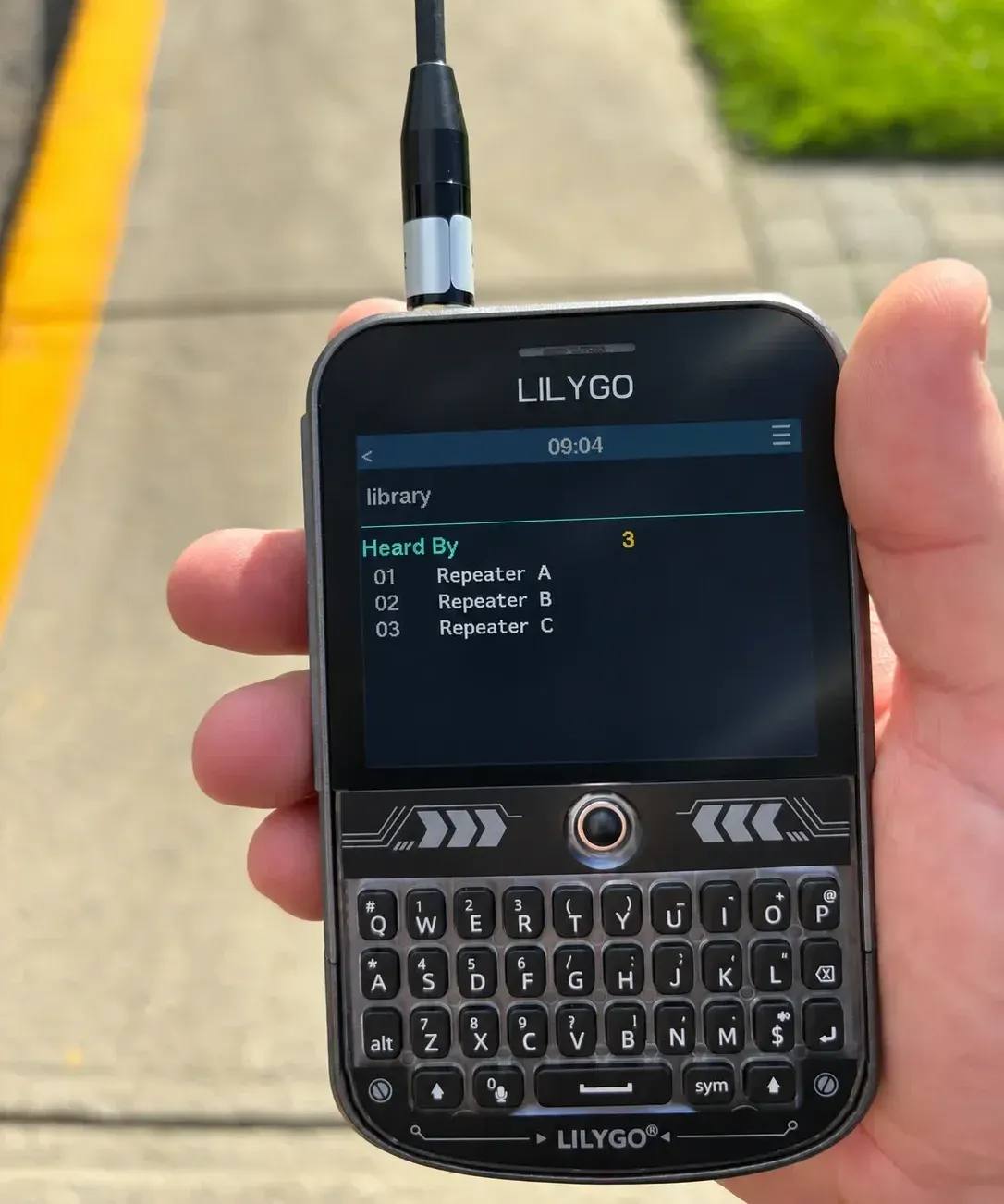
Sending a message across a city usually means relying on infrastructure operated by someone else, whether a mobile carrier or an internet provider. LoRa radios offer another possibility: small devices that exchange short messages directly, with other radios extending their reach by passing those messages along. For hobbyists, building such a network brings together electronics, antenna placement and the familiar curiosity of wondering who might answer.
Our exploration began with a specific goal: connecting two locations without depending on internet or cellular service. Earlier experiments with LoRaWAN and Meshtastic showed both the possibilities and the difficulty of finding a useful connection in an urban environment. MeshCore offered another approach, separating the radios used for conversations from the repeaters responsible for forwarding traffic. It also introduced us to an active community, giving the project an everyday purpose while the original connection remained unfinished.
This article explores how MeshCore works, how we built permanent companion and repeater installations using Heltec radios and ROCK Pi computers, and what happened when we started participating in the local mesh.
Exploring MeshCore
What if you could reach someone kilometres away without relying on cellular service, the internet or a telephone network? Amateur radio enthusiasts have long explored that possibility, building stations and experimenting with antennas to make contact across considerable distances. For a hobbyist, the appeal includes discovering who can be reached, understanding what makes a connection possible, and sharing those experiments with other people. Inexpensive radios using LoRa have opened another way into that hobby, allowing people to exchange short text messages over networks they help build themselves.
Meshtastic was our first exploration of this kind of messaging, although finding a dependable connection through the local network proved difficult. Trying MeshCore brought us into a much more active community, with regular conversations and people exchanging greetings each morning and evening. The original goal of connecting two particular locations remains unfinished, but participating in that community gave the equipment a use beyond sending test messages.
What Using MeshCore Looks Like
The experience has something in common with early internet messaging services such as ICQ or MSN Messenger: one can reach out to another person with the anticipation of someone replying. In MeshCore, a user can send a message using a small radio, either to an individual or to a public channel, a shared conversation where other participants can read and respond to messages. Someone might say good morning, ask whether their new antenna is working, or compare reception with another person across town. These are short text conversations, suited to a radio connection with limited capacity.
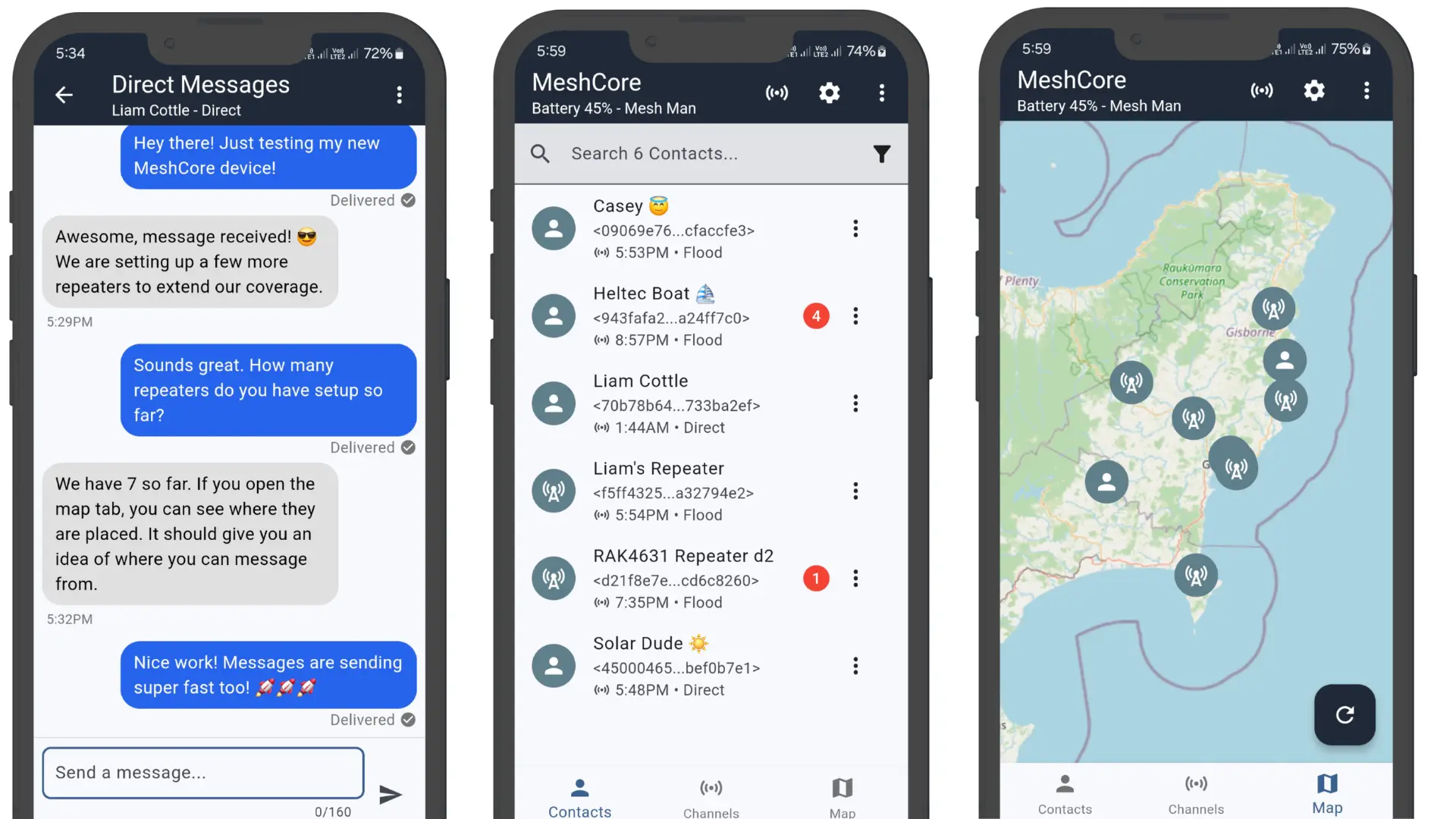
These small, affordable radios can have their own screen and keyboard or connect to a phone that provides the messaging interface. They transmit over shared radio frequencies available for licence-exempt use, meaning users do not need an individual radio licence when their equipment and operation meet the applicable local rules. The radio signal spreads outward from the transmitting antenna, allowing compatible radios within reach to receive the message. How far it travels depends on antenna placement, terrain, buildings and radio settings, so a clear path between elevated antennas can produce a very different result from a pair of radios inside houses. The modest cost of basic radio boards makes experimenting accessible, although finding other people within reach remains essential to joining a conversation.
How the Messages Travel
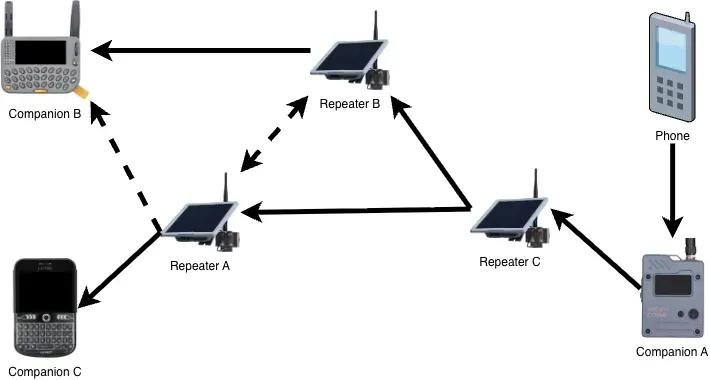
Imagine sending a message to someone on the other side of town. The message starts in the application on your phone, which passes it to your connected radio for transmission. MeshCore calls this radio a companion, and if the recipient’s companion is within range, it can receive the message directly. If the two radios cannot reach one another, a suitably placed repeater can receive the transmission and send it onward. For example, your companion might reach a repeater on a nearby rooftop, which reaches another repeater across town, which in turn reaches the recipient’s companion. Each radio-to-radio step is called a hop, and the recipient can read the message through their connected application once it arrives. These overlapping radio connections form the mesh, allowing communication beyond the range of any one device.
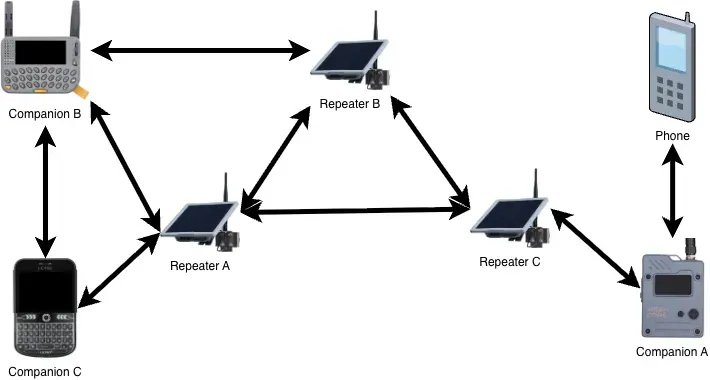
MeshCore separates the radios people use for messaging from those responsible for carrying messages across the network. Ordinary companions send and receive their users’ messages, while dedicated repeaters forward traffic for others. Operators can place repeaters in fixed, elevated locations with reliable power, creating more stable connections between neighbourhoods. In Meshtastic, ordinary client radios can also relay traffic, allowing users to extend coverage simply by bringing another device into range. That flexibility can help a network form, but moving or switching off those devices changes the available connections, and additional relays can increase competition for transmission time. MeshCore’s separation of roles makes it easier to organise that forwarding infrastructure, although useful coverage still depends on people installing and maintaining repeaters where they are needed.
Setting Up a Presence on the MeshCore Network
Getting started with MeshCore can be straightforward: install the appropriate firmware on a supported radio using the web flasher, configure it to match the local network, and connect a messaging application. Making useful contact still depends on having other radios within reach, something our earlier Meshtastic experiments had made clear. We also wanted a permanent installation that could receive messages while we were away, allowing us to return to the conversation later. With ordinary MeshCore companions leaving the forwarding of messages to dedicated repeaters, our plan included both roles: an indoor companion for messaging and an outdoor repeater to contribute coverage.
Companion Nodes
A companion can be as simple as a compatible radio, such as the Heltec V3, paired with a phone over Bluetooth. For our installation, however, Bluetooth access had proved frustrating, and we wanted a stable connection to an application that could keep a history of received messages. mc-webui offered a useful alternative: software running on a computer connected to the radio over USB, with a messaging interface accessible through a browser. Leaving the computer and radio running allows the application to collect messages for later reading without keeping a phone connected. Its observer feature can also forward received radio packets to an MQTT broker, a server that distributes data to other applications, providing a starting point for further experiments.
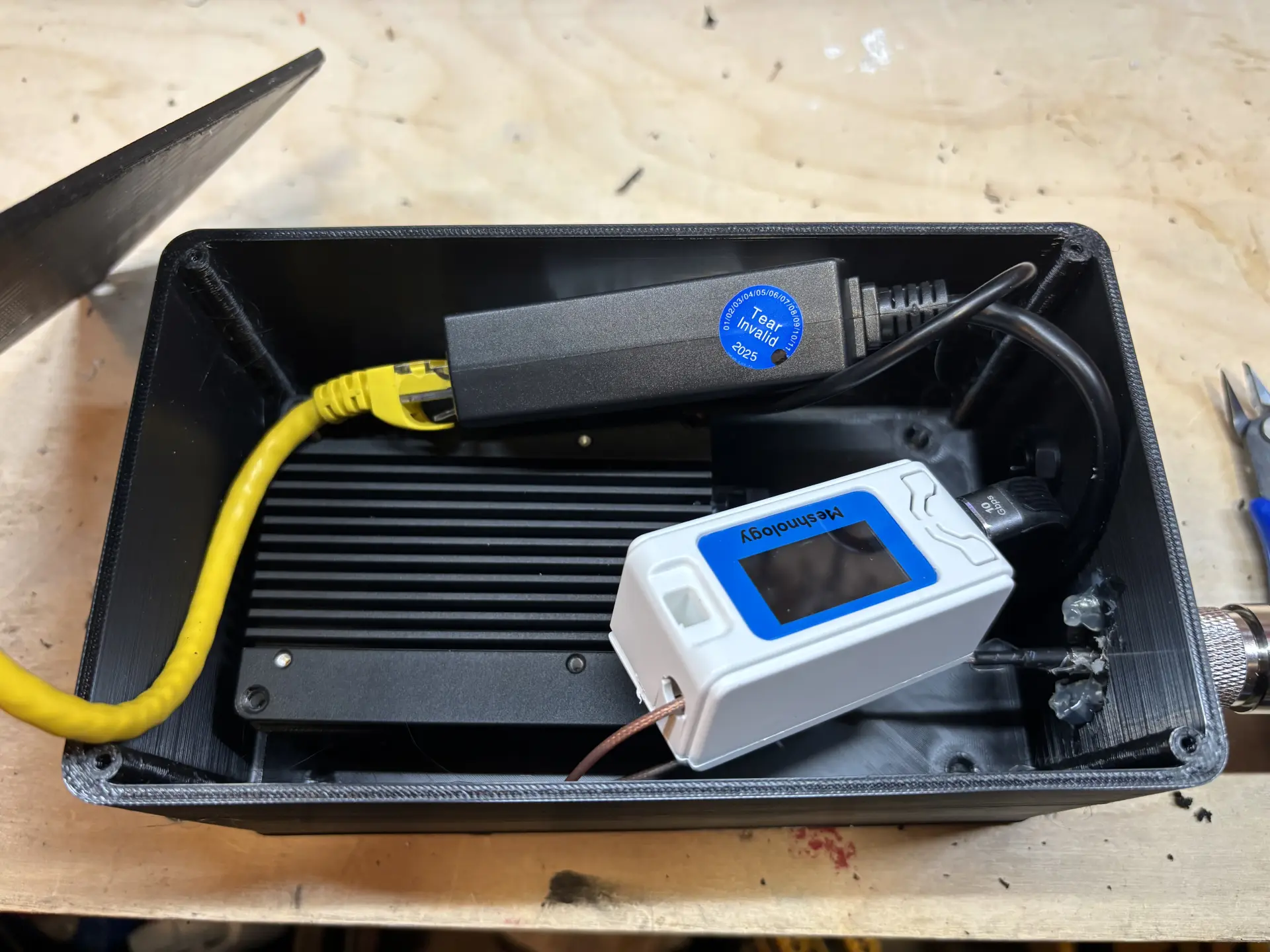
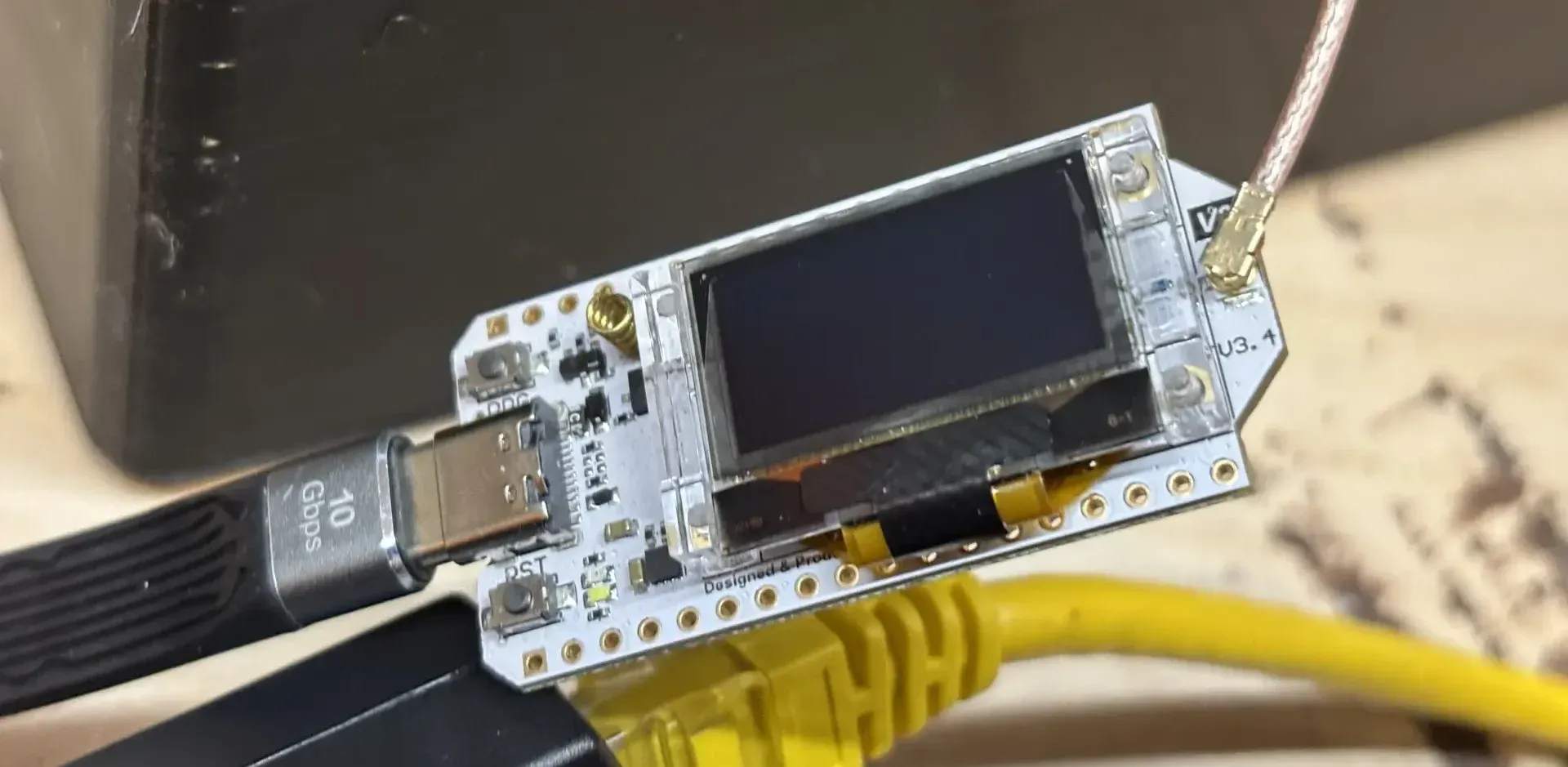
The build started with a 3D-printed box and a Heltec V3 LoRa radio. Having acquired several ROCK Pi 4B Plus boards earlier in the year, we already had small computers available to run mc-webui, and one fitted inside the companion enclosure alongside the radio. A short USB-A to USB-C cable connected the two, while a PoE splitter allowed the assembly to receive power and network connectivity through a single Ethernet cable. We fitted a keystone network jack to the enclosure and mounted an N-type antenna connector at the top, linking it to the radio with a short RG178 cable. The external 915 MHz antenna was advertised with a gain of 5 dBi.
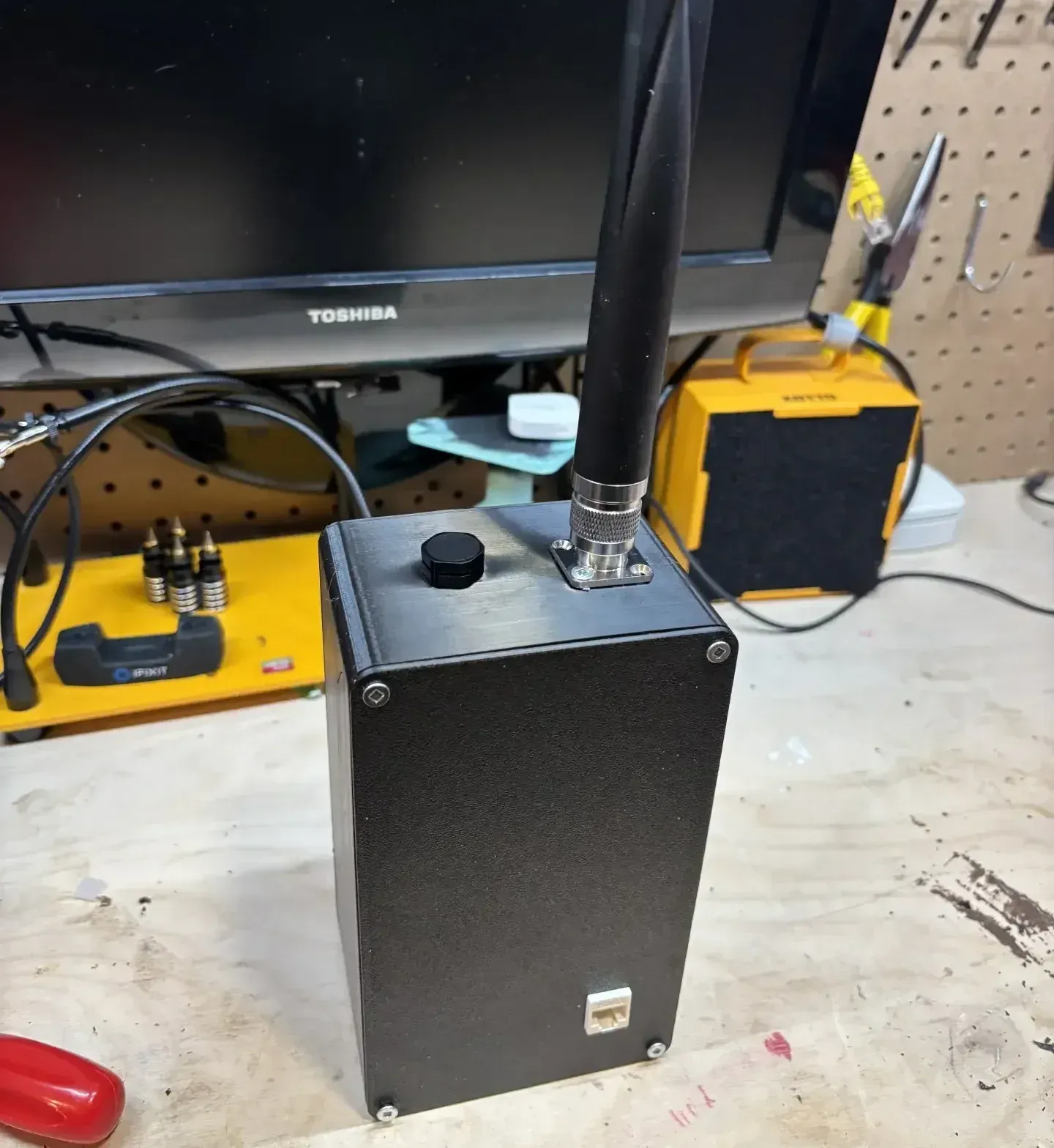
The result was a compact, discreet build intended to sit on a shelf, preferably in an elevated position with a useful path to nearby nodes. PoE made placement convenient wherever we could run a network cable, without also needing a power socket beside the box. The computer also retained its original maintenance role, giving us a wired connection for configuration changes and firmware updates as well as everyday messaging.
Repeater Nodes
For the repeater, an outdoor installation offered more freedom to position the antenna clear of the house, but required an enclosure suitable for exposure to rain and seasonal temperature changes. We chose a hinged ABS junction box sold as IP65 rather than printing another enclosure. Keeping the radio inside the box close to the antenna also avoided a long antenna cable, which would introduce additional signal loss. Solar power can make sense where a node has no nearby electricity supply; at our location, access to reliable PoE made a wired installation the more convenient choice.
For installations beyond the reach of a network cable, other builders have documented solar-powered alternatives. AJ Quick’s solar-light conversion adds a RAK WisBlock Mini to an outdoor light, reusing its panel, battery and enclosure. Mazzo.me’s Heltec T114 build takes a different approach, assembling a solar panel, charge controller and batteries in a dedicated enclosure, with component photographs and a wiring diagram showing how it fits together.
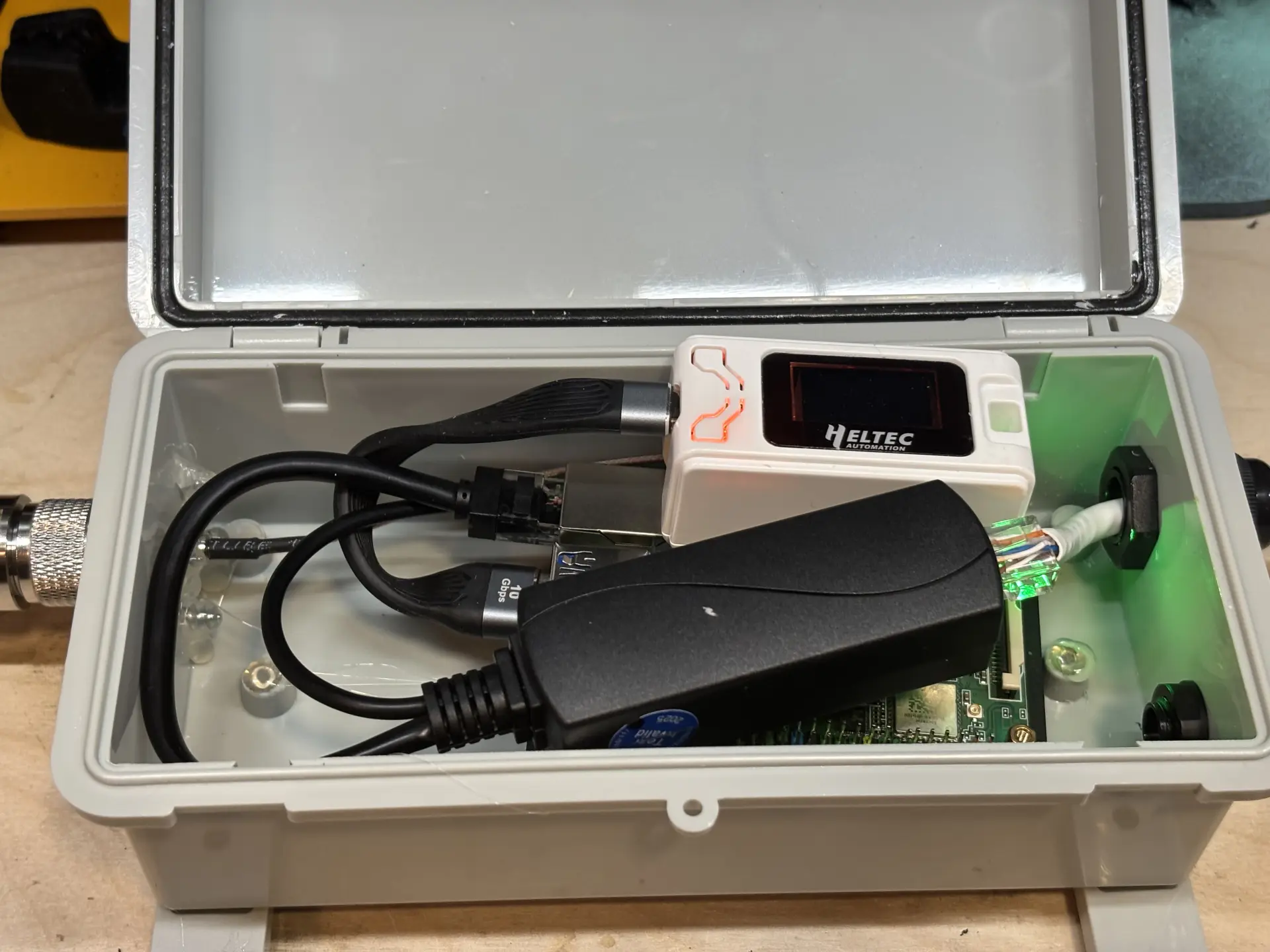
Maintenance was another reason to carry the companion’s computer-and-radio arrangement into the repeater. Updating our earlier Meshtastic installation had meant taking a laptop outside and connecting it to the node, an inconvenience that would become greater with equipment mounted somewhere difficult to reach. A ROCK Pi connected directly to the Heltec lets us access the computer remotely over SSH, a network connection for running commands, and perform maintenance through its USB connection to the radio. We prepared the board using the process covered in our ROCK Pi flashing article. The repeater does not need this computer to forward messages, but it makes the installation easier to manage while sharing the same cable for power and network access.
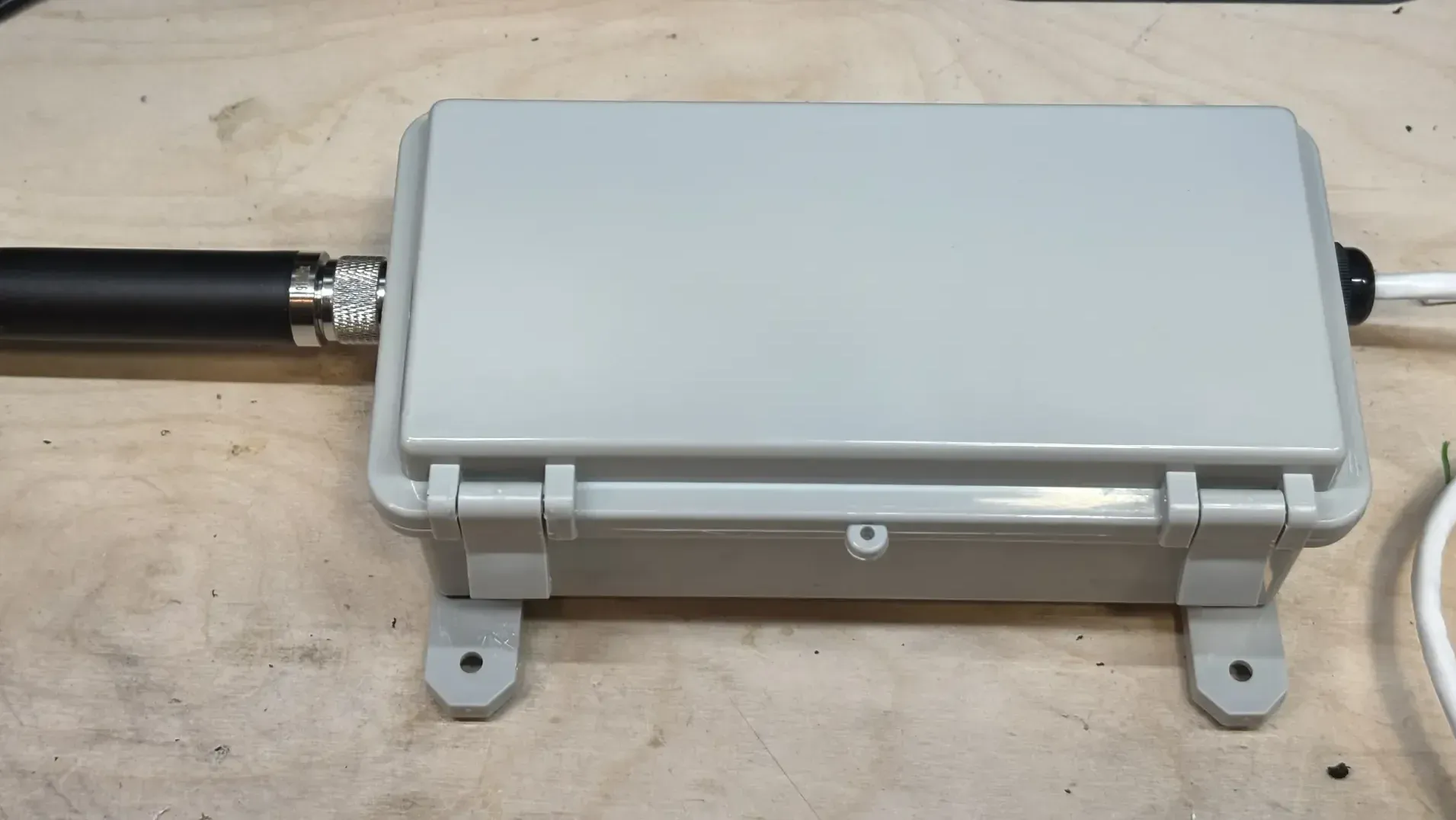
Inside the enclosure, the main components remained a Heltec V3, a ROCK Pi 4B Plus and a PoE splitter. We paid particular attention to the openings: rubber foam beneath the antenna mount helped seal its connection to the box, and an M16 cable gland sealed around the incoming Ethernet cable. An M12 breathable vent provided a way to equalise pressure as the air inside warmed and cooled. We tested the assembled enclosure by spraying it with a water hose for 15 minutes, giving the seals a practical check before relying on them outdoors. The finished design combined a single incoming cable with remote maintenance, making it practical to install the repeater outside without needing routine physical access.
Finding a Community on the Other End
The original goal of these experiments was to connect two specific locations in the city without relying on an internet or cellular connection. That goal remains unfinished: the second location is still too far from the city mesh to reach other participants reliably, despite returning to the experiment every few weeks. Building a permanent installation has made the equipment easier to use and maintain, but it has not overcome the gap in radio coverage. That said, our experience with MeshCore at the primary location has significantly improved our appreciation of mesh technologies.
Our earlier Meshtastic experiments could feel lonely, even when the equipment was working. On the local MeshCore network, people exchange good mornings and good nights, discuss their installations and respond to one another’s experiments. It has something of the atmosphere of an amateur radio community, with familiar participants returning to a shared channel and an interest in how everyone’s equipment is performing. Like earlier Internet chat technology (IRC), there is a reason to check in because someone might be there to answer. Having mc-webui keep a history of received messages makes it easier to follow those conversations when we return.
Exploring the surrounding area showed how much coverage other people’s installations contribute to the experience. Our own repeaters, mounted without much elevation, were heard reliably at around 500 metres and as far as one kilometre away. With the wider mesh available, we could reach a city node from the places we visited on walks within roughly five kilometres of home. The conversations themselves stretched further, bringing together people in neighbouring cities and occasionally someone flying overhead. With so many people sharing the public channels, participants began discussing ways to keep some broadcasts local, so that everyday chatter in one city would not travel across whole provinces and beyond.
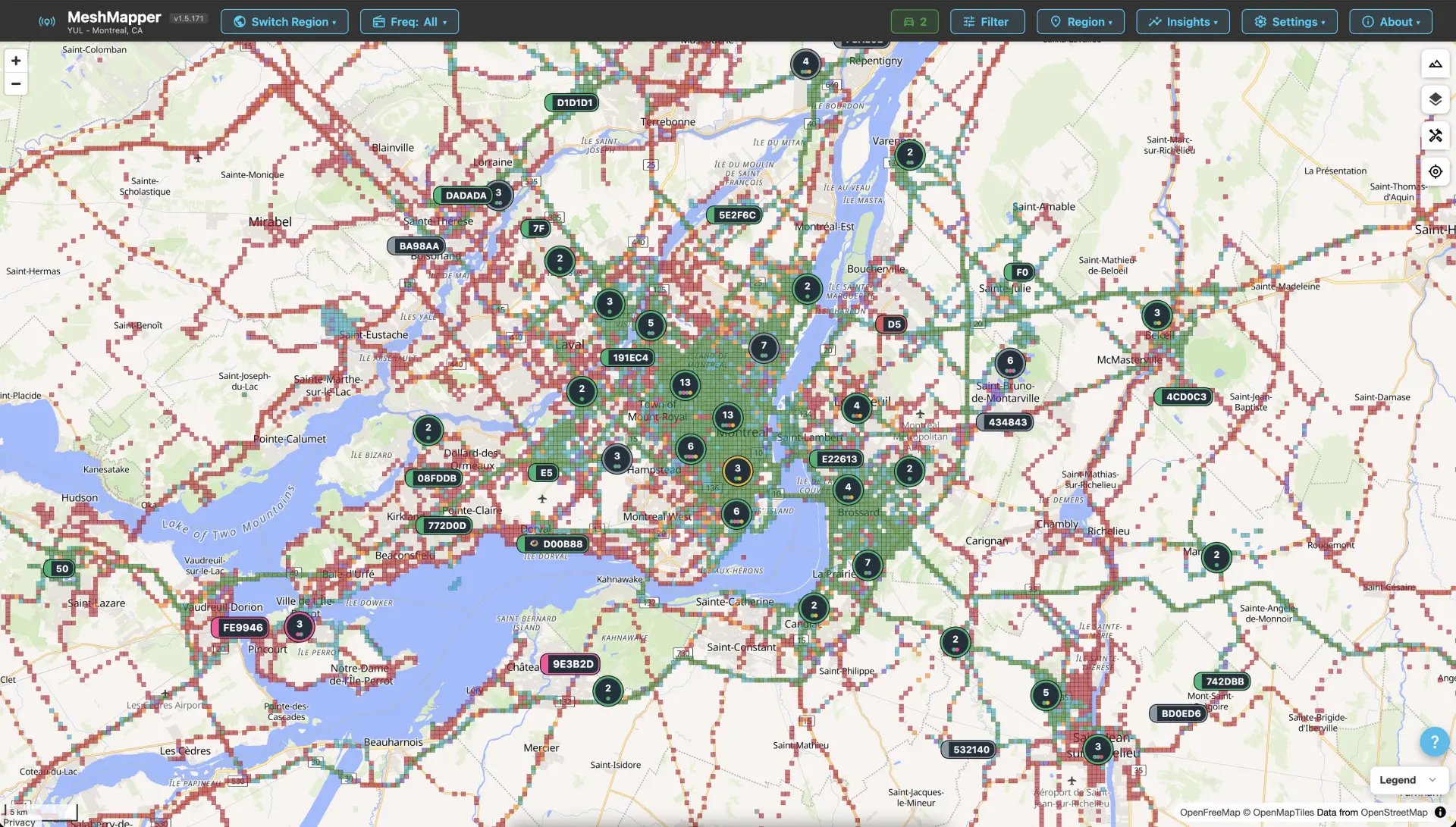
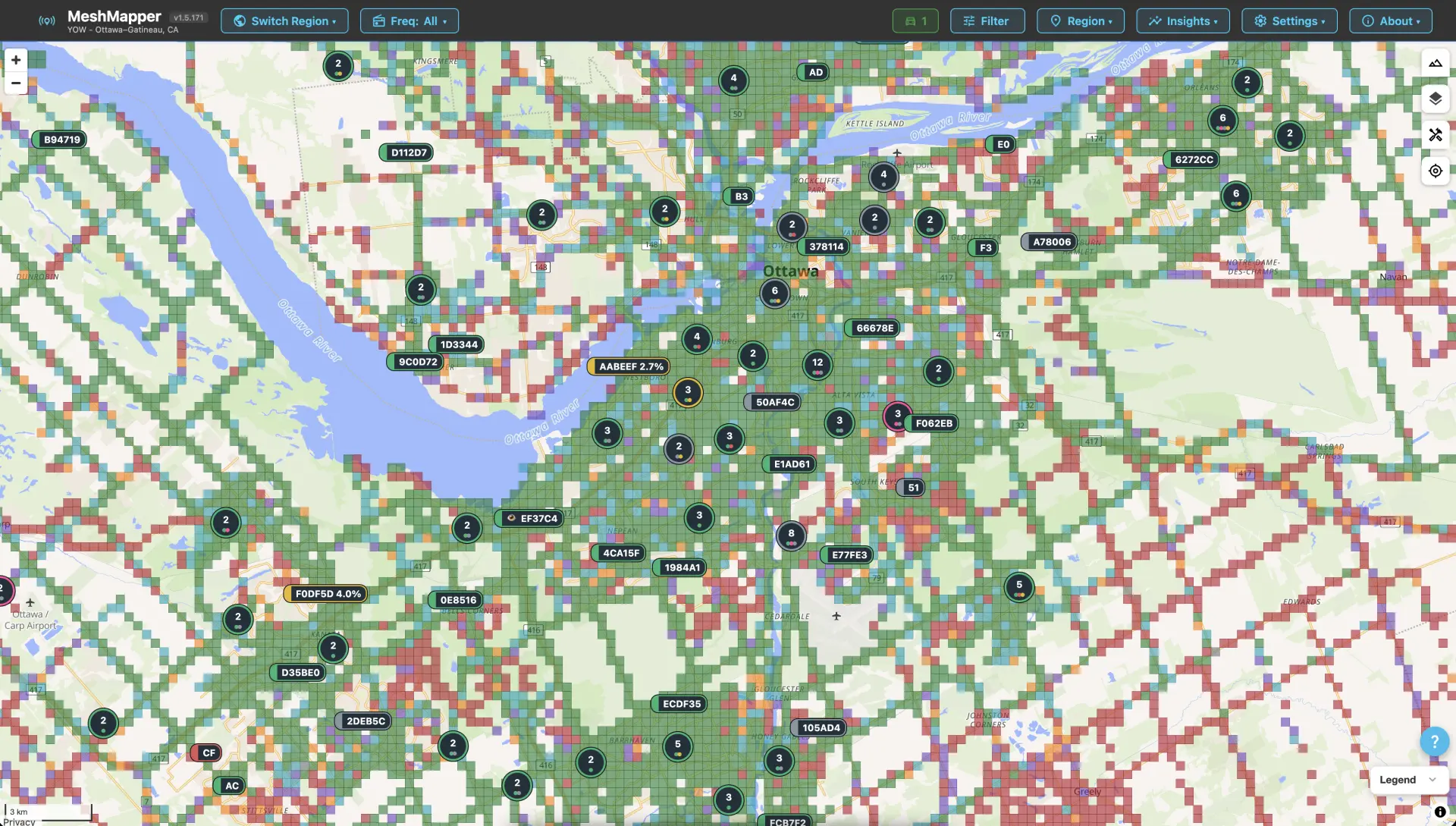
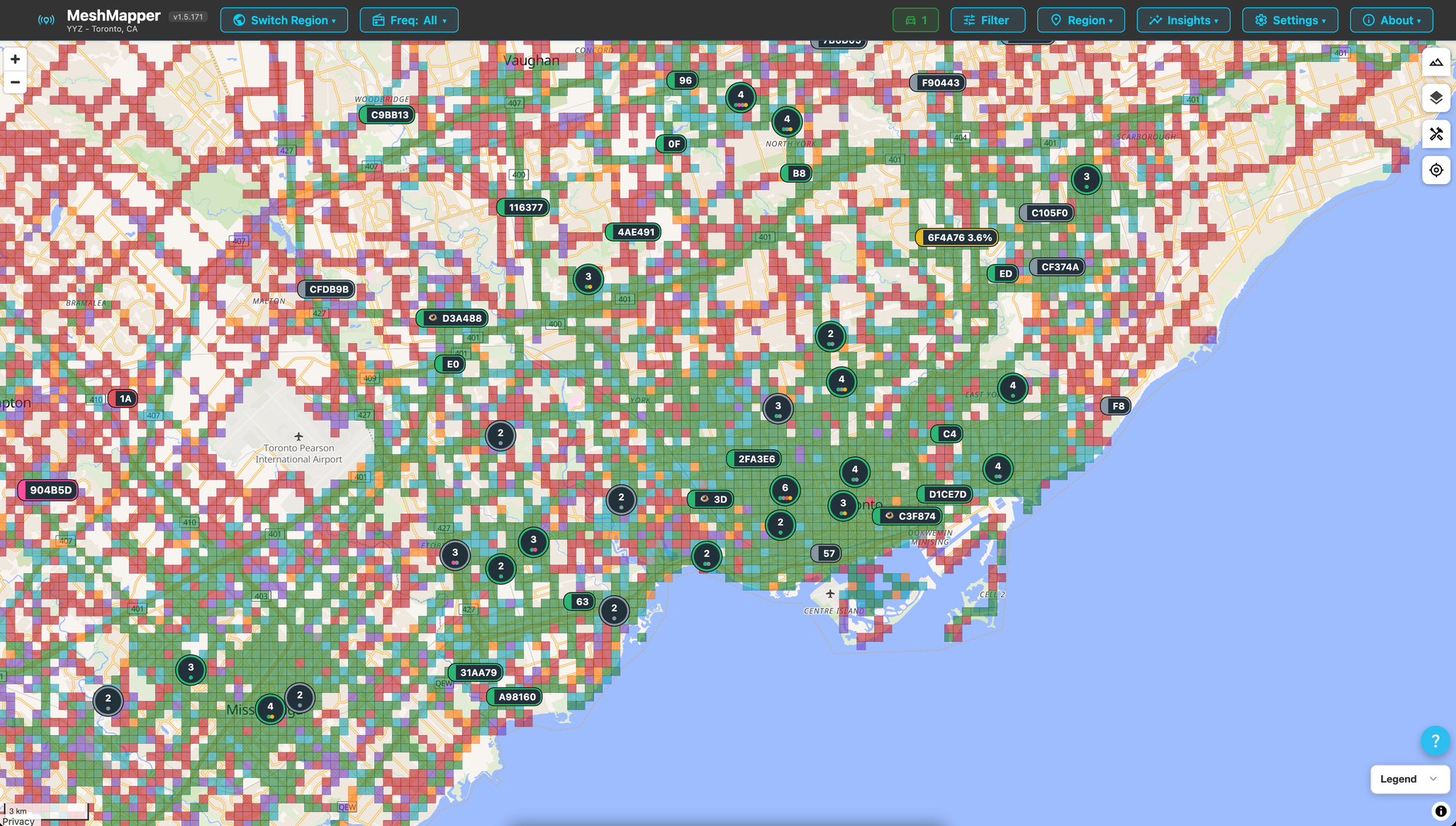
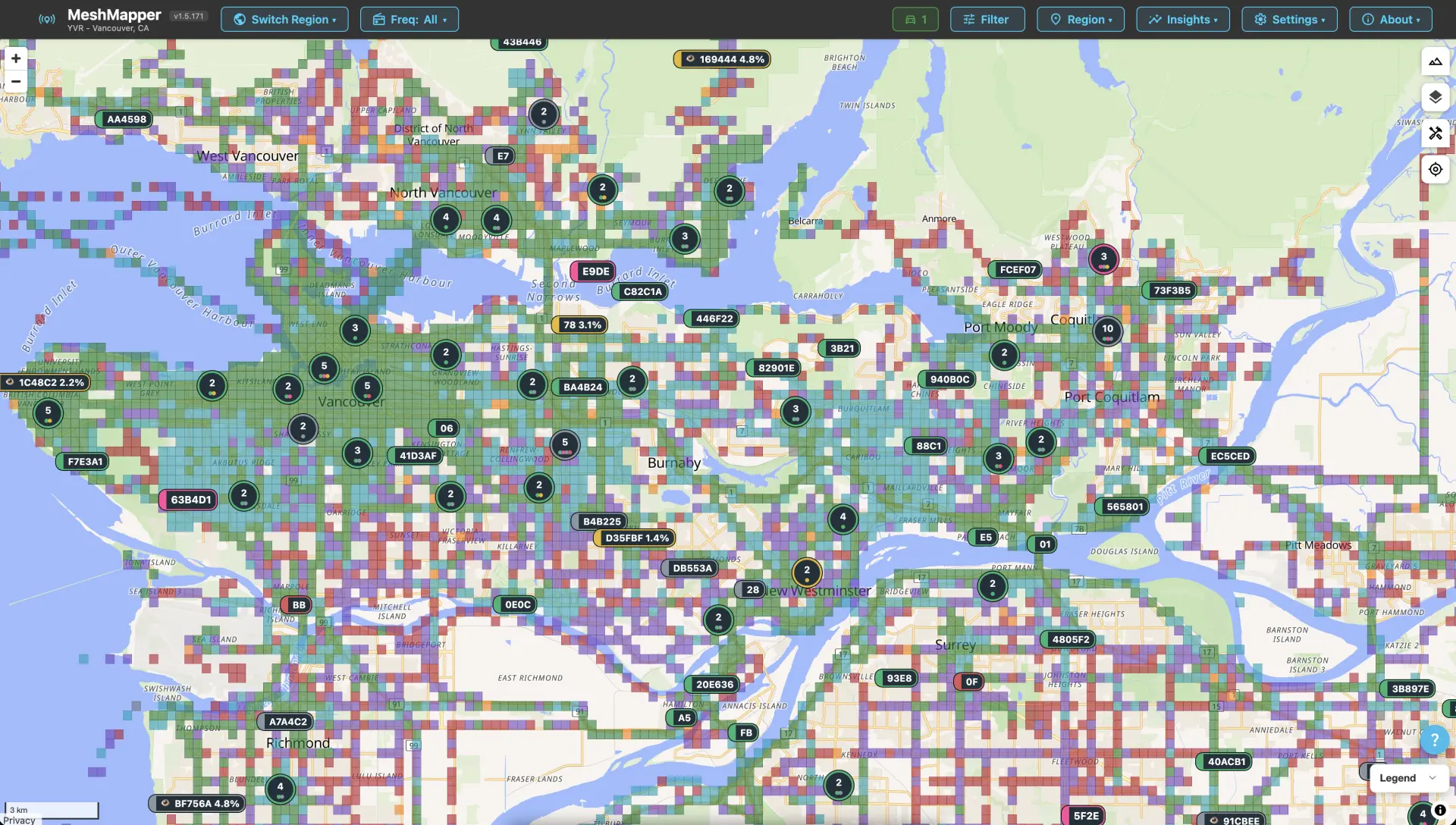
There are public communities to explore across Canada, each offering a way to find people before choosing equipment. In Vancouver and the Lower Mainland, WestMesh provides an entry point into a broader Western Canadian MeshCore community. For the Toronto area, CedarMesh shares resources for both MeshCore and Meshtastic, including dashboards, field notes and tools for estimating solar runtime and radio performance. The Greater Ottawa Mesh Enthusiasts maintain setup guides and a repeater showcase that documents the physical installations supporting their network. In Montreal, Réseau Libre publishes guides and community documentation, with a current focus on MeshCore alongside experiments with Reticulum. Similar communities can be found across the world. These groups make the work behind a mesh visible: people finding suitable sites, maintaining equipment, sharing observations and helping newcomers get connected.
Community contributions also extend to the software people use to explore the network. MeshTerm is a community-developed MeshCore client that runs in a computer terminal, with a keyboard-driven interface for channel conversations and direct messages. Its developer describes tools for recording node announcements, displaying maps and tracing message paths, giving users ways to investigate the network as well as talk over it. Projects like this provide another way to participate in the hobby, by building and sharing tools that other people can use.
The lesson from our exploration is to investigate what is active nearby before deciding which technology to adopt. MeshCore made the difference because of the people using it in our area. Another location might offer a more rewarding community around Meshtastic or Reticulum. Technical choices still matter, but a capable radio and an elegant protocol cannot supply the participants who make a conversation possible.
Which mesh networks are active in your area, and what helped you make your first contact? To follow this exploration of mesh networks with another approach to building wireless infrastructure, our article on the Helium network examines how it combines LoRaWAN with cryptocurrency incentives to reward network participation.